Every time a senator or representative goes home, I want them to see a Boilermaker somewhere to remind them that everything they do in D.C. affects the real, rank-and-file members of this union.
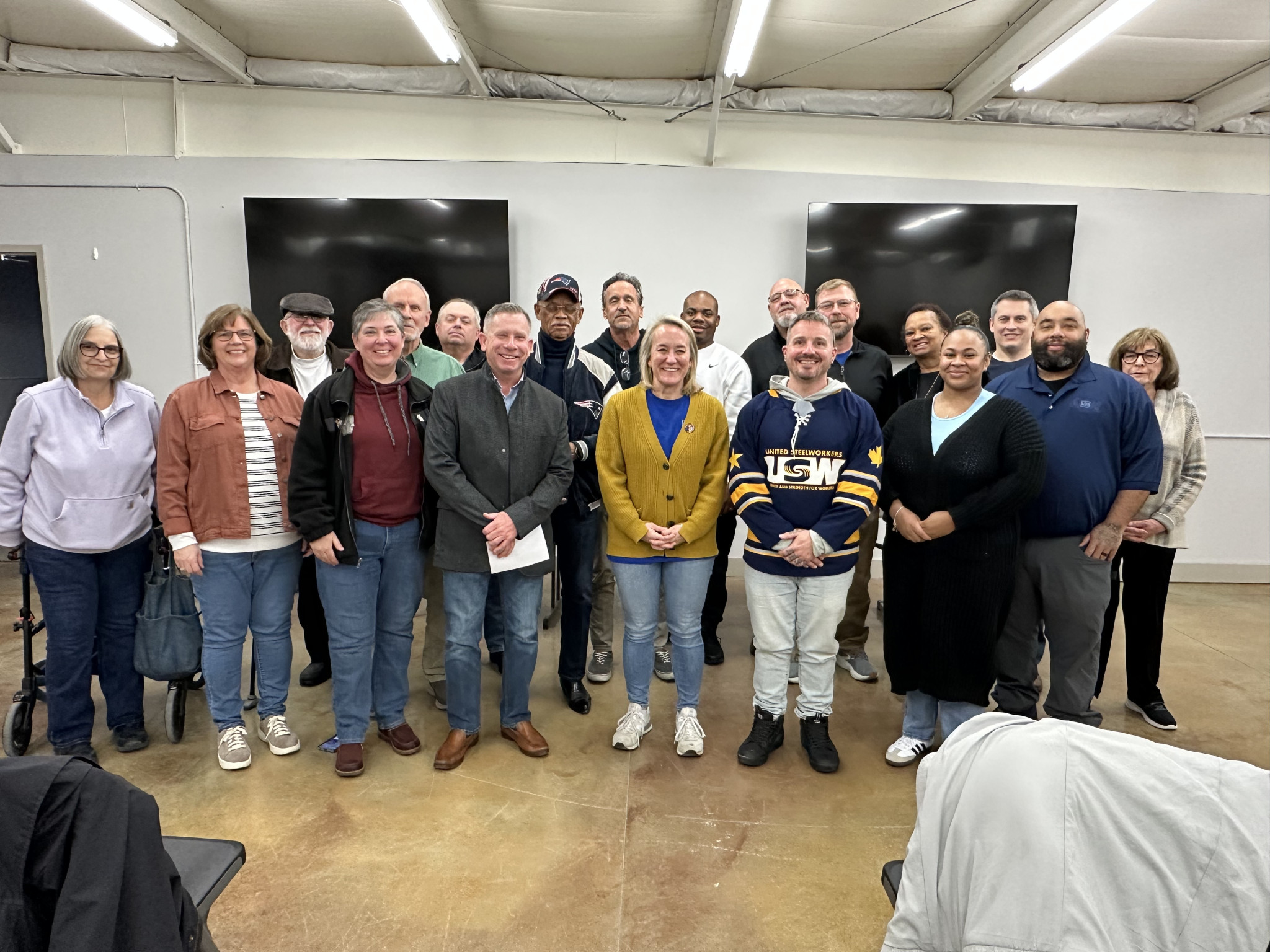
State Legislative Coordinator Bill Mulconnery, front row, fourth from left, stands with Congresswoman Nikki Budzinski (IL-13), fourth from right. Mulconnery and other local union leaders met in February with Budzinki, who serves on important congressional committees including the Congressional Building Trades Caucus, Congressional Apprenticeship Caucus, Congressional Career and Technical Education Caucus, Veterans Affairs Committee and the Sustainable Energy and Environment Coalition.
The Boilermakers' new State Legislative Program launched this year. It’s building tangible influence at the state and local level, across every sector, so that decisions shaping Boilermaker work always include Boilermaker voices.
Right now, a member’s statehouse may matter more than Congress. Energy permitting, project approvals, prevailing wage protections, labor law and economic development decisions are a significant portion of what affects Boilermaker jobs. Many times, these are decided at the state and local level. And at that level, one motivated Boilermaker with relationships can change outcomes in ways that are simply not possible at the federal level. That’s what the State Legislative Program is all about.
It works in tandem with local lodges—both Construction Sector and Industrial Sector locals. When a member sees an issue in their community or state that is poised to affect jobs, they can contact lodge leadership or the designated political representative at their union hall. If the local determines the issue needs to be addressed, leadership then contacts Legislative Coordinators to design a plan to tackle the issue.
Industrial Sector Operations Executive Director Don Hamric wants ISO lodges to understand the importance of political engagement.
“For union leaders in the Industrial Sector Operations Division, political engagement is not optional, it’s how we defend our members jobs, provide a safe work environment, strengthen our bargaining power, and ensure working families have a voice in decisions that shape our industry,” he said.
The State Legislative Program is supported by a team of seasoned Boilermakers who have deep experience in government affairs. These Regional Legislative Coordinators are important resources. Their job is to support local lodges in building relationships, navigating state and local politics and implementing a plan to influence the political machine where it’s needed.
It’s a role Tim Jefferies helped pilot in the Western States some months ago. Bill Mulconnery, a 38-year Boilermaker and former Business Manager, covers an expansive territory stretching from the Great Lakes to Texas. Bob Hutsell, former L-169 (Detroit) Business Manager, supports that region, helping build Boilermaker presence across the Great Lakes. And L-154 (Pittsburgh) Business Agent Shawn Steffee contributes to the program's efforts in the Northeast.
"Why wouldn't we be involved?” said Mulconnery. “These are the people making the laws we live under every day. These are our jobs, our benefits, our families."
An area RLC is a resource for local lodges and can help identify the key legislators, connect with the state Building Trades Council or state AFL-CIO, and accompany lodge leaders to their first meetings with elected officials. RLC’s keep informed on what’s moving legislatively and help lodges strategize and strengthen Boilermaker influence at every level.
“You don’t have to figure out the state and local landscape alone,” said Director of Government Affairs Bridget Martin, who spearheads the program. “If you’re hearing concerns about overtime pay, collective bargaining threats, potential plant closures or jurisdictional disputes, inform your RLC. They’ll tell you where to go and what to do when you get there.”
This program is in its early stages, but the results already speak for themselves. In Wisconsin, when members faced the loss of funding for shipbuilding, which meant the loss of jobs, they chose to fight it through a letter-writing campaign. It was worker-led, specific to their community and sent directly to decision-makers in Washington.
In California—a state where the pressure on Boilermaker refineries and power plants is constant—Boilermakers have earned a seat on the governor's advisory committee. Not by waiting to be invited, but by showing up and staying there.
"You want to know why California hasn't shut us down yet?" asked Jefferies. "Because we showed up. We built the relationships. We got on the committees. It works. And if it works here, it works anywhere."
Another example of the importance of getting involved in state-level politics happened in the Northeast. Pennsylvania State Senator Joe Pittman said it best when he introduced Steffee at a recent public event: "The members of this union won't have to pack suitcases to go to a job. They'll pack lunchboxes."
That moment was the culmination of a years-long effort by Steffee, Local 154 and Pennsylvania’s building trades to protect Boilermaker jobs in the state by defeating RGGI, the Regional Greenhouse Gas Initiative. As president of the South Central Building Trades Council, Steffee helped ensure Boilermaker priorities weren’t just represented; they helped drive the agenda. The results are already visible. Hundreds of Boilermakers are now working closer to home on major power generation projects across Pennsylvania that would have gone elsewhere just a few years ago.
"I was born and raised in southwestern Pennsylvania,” Steffee said. “My family, my grandchildren, everybody lives here. I want clean air and clean water. I also want a job. I think we can get both."
That's exactly what the Boilermakers' new State Legislative Program is designed to make possible in more states and across more sectors. The program was born from a simple but powerful observation that the decisions that matter most to Boilermaker members don't always stay in Washington. They come home.
"The reason this State Legislative Program was started was because we needed to take the issues we have in Washington, D.C., and bring them back to the states," said International President Timothy Simmons. "Every time a senator or state representative goes home, I want them to see a Boilermaker somewhere to remind them that everything they do in D.C. or at the statehouse affects the real, rank-and-file members of this union," he said. "We have got to let the politicians know that if they don't vote for us in D.C., they are going to see us at every ribbon cutting, every time they shake a hand and every time they kiss a baby. We are going to show these congresspeople that we are strong; that we are represented."
Resources:
Find your Building Trades Council: nabtu.org/about-nabtu/official-directory
Find your state AFL-CIO: aflcio.org/about/leadership/state-feds-clcs
Contact the State Legislative Program: IBB_stateleg@boilermakers.org
Get involved in a letter-writing campaign to save our shipyards: www.saveourshipbuilding.com