They know the skilled craftsmanship the Boilermakers provide, and they trust the Boilermakers to get the job done right the first time.


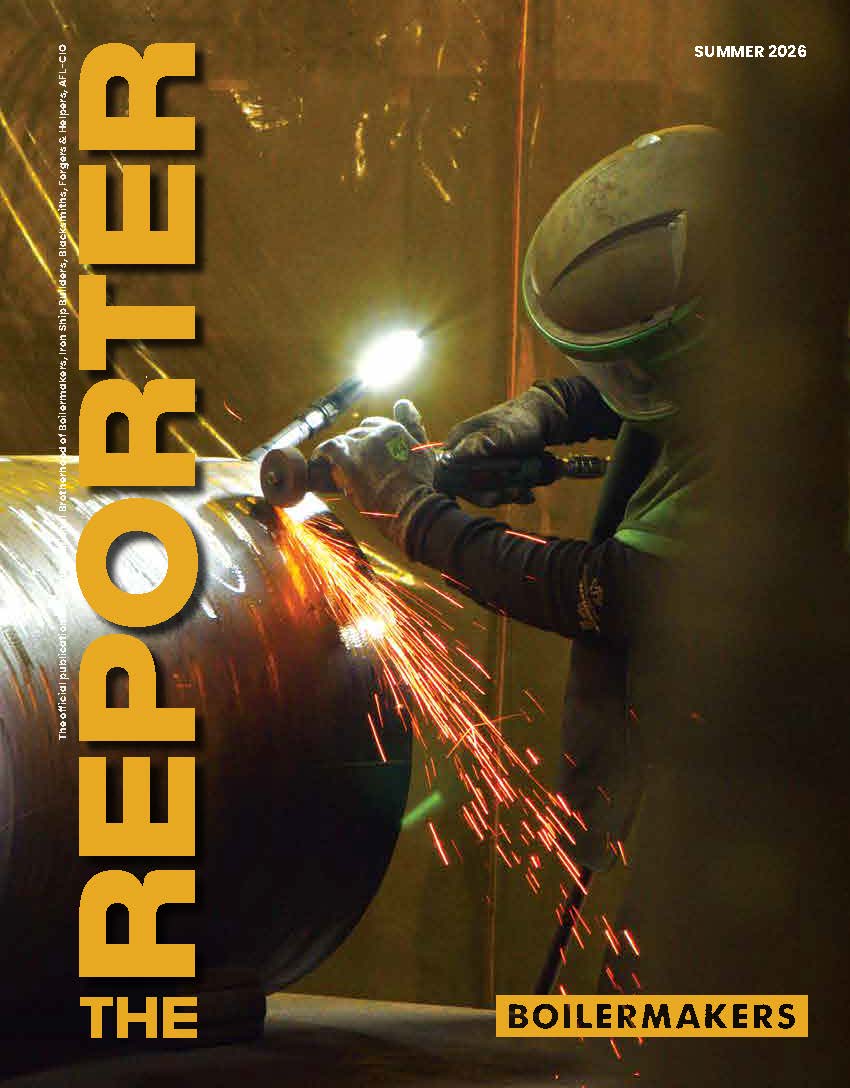
Boilermakers work the a fall outage, bread and butter work for L-455 and others who count on the seasonal work.
View Photo Gallery (11 photos)
The relationship between the Boilermakers who work Tennessee Valley Authority’s Cumberland Fossil Plant outages and their employer, TVA, is just about as symbiotic as the Cumberland River and its iconic surrounding valley itself. It’s a partnership.
A lot of households and businesses count on Cumberland City’s two coal-fired units to reliably produce 1,250 megawatts (each) of power at peak. So, TVA depends on the highly skilled and trusted Local 455 (Muscle Shoals, Alabama) Boilermakers to man their twice-a-year outages and make sure the units are ready-to-go ahead of the peak usage seasons. And Boilermakers rely on the work the regular, steady TVA spring and summer outage gigs provide.
“The relationship between TVA and the Boilermakers union continues to be strong, and they have been essential, especially during outages,” says Tammy McMillan, Outage Manager for TVA at Cumberland. “With their craftsmanship, we can get a lot of work done in the planned outage timeframe.”
The fall 2025 outage, for example, was 75 days from shutdown to restart and included boiler work, module work, precept work and work in the condenser. For construction sector Boilermakers across the U.S. and Canada, it’s nothing too exotic.
“They bring in boiler inspectors to determine the scope of work that’s needed for the boiler, whether the tubes need to be pad welded or cut out and replaced…and the Boilermakers work the punch list on what needs to be done in the boilers,” explains International Rep Mitch Brown, noting the plant runs 24/7 at max capacity during the peak summer and winter electricity months. During the planned outage, the units are taken offline and worked on one at a time.
“They’re changing out the baskets and SCRs, and they’re at the scrubbers and doing the work on the lining of the cans,” Brown says.
It’s all pretty standard outage, turnaround and maintenance work. But it’s also the kind of work that’s bread and butter for Boilermakers—and especially coveted for those who live nearby—and TVA has plenty of it.
Allen Bieda, a 25-year L-455 Boilermaker who lives a short drive from the Cumberland plant, appreciates the chance to work close to home. Like most Boilermakers, he has known all too well in his career what it’s like to travel for work, missing birthdays and important family moments so he could chase the work, wherever it was.
“Being with TVA, it really helped out. I’m home every night,” he says. He knows he’s lucky. Good-paying jobs are hard to find around Cumberland City. He can ultimately thank his father-in-law for encouraging him to check out the apprenticeship program at the union hall after he completed his service in the U.S. Army. Bieda, who grew up in California, came to the area after being stationed in nearby Clarksville, Tennessee.
“I love it here. I met my wife here. We have family here; so, it’s definitely where I want to be,” he says.
Brown says the site is the backbone of this area.
“There is nothing here but these jobs,” he says. “If you live in Stewart County, Tennessee, or if you’re a transient construction worker… or you work on the riverboat or you work in the cement industry or you work in construction hanging wallboard, it’s because of the jobs at this plant.”
The TVA was founded during the Great Depression, in 1933, by Franklin D. Roosevelt under the United States’ New Deal to address the severe economic hardship in the Tennessee Valley area. The region faced widespread poverty, frequent flooding, lack of electricity and poor agricultural conditions. As a federally owned corporation, TVA sought to modernize the region by building dams for flood control, generating affordable hydroelectric power, improving navigation on rivers and promoting agricultural and industrial development. TVA was one of the most ambitious, impactful government programs of the era and resulted in bringing electricity and infrastructure to rural areas, stimulated economic growth and improved quality of life.
Today, including the Cumberland Fossil Plant, TVA’s energy-generation portfolio includes three nuclear plants, four fossil plants, 17 natural gas plants, one diesel generator site, 29 hydro plants, nine solar energy sites and one pumped storage hydroelectric plant. And it’s growing. TVA provides electricity to about 10 million people across Tennessee and parts of six other adjacent states.
Just down the road from the Cumberland Fossil Plant, Boilermakers are building a new natural gas plant set to produce 1,450 megawatt of energy—enough to power about 840,000 homes. The original plan was to retire the coal-fired plant, but now both power-generation sources are needed to keep up with increased energy demands driven by data centers and artificial intelligence.
“The needed power resources are probably higher than expected, and coal plays a big part in providing that power,” says Jason Sills, TVA Senior Manager, Outage. “Coal is not dead.”
It’s an important part of TVA’s energy portfolio, and it’s reliable. But it has been unfairly labeled as “dirty.”
“Which is not the case at TVA,” McMillan says. “We have emissions controls on all of our equipment here. So, what’s actually coming out of the stack is nothing more than just steam—and it’s clean. I explain it like I do to my grandkids: That’s clean clouds we are producing here. Just clean clouds coming out of the stack. It’s nothing more than just clean steam.”
In addition to being integral to the TVA’s reliable energy portfolio, Brown points out coal is a readily available natural resource. It’s also woven throughout the area’s economy—and other Boilermaker industries. Emissions control byproducts like fly ash go into cement; slurry is dried into gypsum used in the sheet rock and agricultural industries.
“What I really like about coal is the jobs it provides,” he says. “You’re producing electricity, you’re providing the maintenance, you’re producing jobs for the cement industry, you’re producing jobs for the wallboard industry. You’re providing jobs for the riverboats and the tugs bringing the coal in—which most are built by Boilermakers. Then you’ve got the coal mines and the men working in the mines. And then you’ve got the heavy mining equipment Boilermakers make at Komatsu (Local 158, Peoria, Illinois). It’s just a domino effect on how many jobs this one site [Cumberland Fossil Plant] creates.”
The Boilermakers union and TVA have worked together since the beginning.
“They know the skilled craftsmanship the Boilermakers provide, and they trust the Boilermakers to get the job done right the first time,” says Jeff Campbell, International Vice President-Southeast Area.
The Southeast Area Boilermakers don’t take their relationship with TVA for granted.
“TVA is the lifeblood of L-455. That is predominant work,” says Edwin “Tres” Howard, L-455 Business Manager/Secretary-Treasurer. “We have smaller jobs elsewhere, but District 57, which L-455 is part of, we’re set up to handle the TVA sites.”
That’s a good thing, because according to Matt Faulkner, TVA’s director of labor relations, the surge in energy demand is also creating a demand for skilled labor. At the recent Boilermakers Construction Sector Conference in Marco Island, Florida, he said workforce availability is one of TVA’s greatest challenges. One of the ways TVA is meeting the challenge is by increasing apprenticeship by asking their contractors and craft unions to staff work at 33.3% apprentices.
For the Boilermakers, it’s working well. At the fall outage, where Howard says the ratio was closer to 45% apprentices, journeymen overwhelming reported positive experiences with the apprentices.
“That’s how apprentices learn to be good Boilermakers, so it worked well here in Cumberland City,” he says. “They’re doing great, and I heard no complaints.”
It starts, he says, with steady recruiting and solid training from lead instructor, Zach Hamilton.
“So, we’ve got a lot of new apprentices already having the skills for the jobsite,” he adds. “It’s needed, because there’s a lot of work coming up. TVA’s talked about the speculative manpower needed for the next several years, and there’s a lot of new building going on.”
That’s good news for apprentices like L-455 third-year apprentice Ayden Maldonado, who worked the outage last fall.
“It’s a lot of intricate, critical stuff we do,” he says. “A lot of pressure behind the welds and very expensive is something goes wrong. This has taught me how to work safely; how to do things the right way. We have a sense of urgency with a lot of things, but above that is safety and doing things correctly.”
Gaining practical experience on jobsites working with mentor journeymen provides the perfect setup for success for apprentices like Maldonado—and for a cycle of success for the Boilermakers. And if Cumberland Fossil Plant outage is any indication as a model, the immediate and long-term future looks bright for the Boilermakers and TVA.
“Our relationship with TVA is more like a partnership, and with the energy renaissance that’s coming and all the work TVA has coming in the future, that partnership is going to continue for a long time,” says Campbell.