Every improvement we make is about strengthening opportunities for our members and creating a path forward for the next generation of Boilermakers.

Ending corruption, restoring trust.
In March of 2023, after fiscal mismanagement and alleged theft were uncovered, four members of the International Executive Council stood together to remove the sitting International President. This concerted action began the process of putting our union on the path of fiscal responsibility and restoring the confidence of our members in its leadership.
The path forward has not been easy. As time progressed, more issues were discovered, and additional corrective actions had to be taken. The IEC proceeded with the knowledge that was available at the time and began reviewing internal policies and procedures to make certain mistakes of the past were corrected and would not be made again.
We had many changes along the way, including officers and other staff. Just as we believed things were stabilizing and we were finally able to move forward, indictments for alleged criminal activity came from the Department of Justice.
To better understand the situation, in less than three years our organization removed a sitting International President for the first time since 1929. In addition, the International Executive Council was tasked with the filling of vacancies, per Article 4.5 of our Constitution, of two International Presidents, two International Secretary-Treasurers and two International Vice Presidents.
The International President and International Secretary-Treasurer positions are currently held by two members who understand how each action and decision made by the leadership of our union affects our rank-and-file members because we came from the field. As a matter of fact, all our current IEC members began working under Boilermaker negotiated collective bargaining agreements in the field construction industry or a Boilermaker industrial facility and were elected by their respective local lodges to leadership positions, such as Business Managers, Secretary-Treasurers and Presidents.
As members are aware, there is ongoing litigation connected to the indictments issued on the former officers of the organization. Through this process, the current IEC has carried out its due diligence to serve members to the best of our ability. The IBB defended the decision to remove former president Newton Jones in federal court in Kansas City, Kansas, and again when that decision was affirmed by the 10th Circuit Court of Appeals in Colorado (see the link to the court decision at the end of this commentary).
The IEC also fulfilled its fiduciary responsibility to do all in our power to hold Jones accountable to repay money we believe was improperly spent, beginning with the money identified in the Article 17 charges filed by IVP-NE John Fultz. As directed by the IEC decision related to the charges against Jones, a nationally recognized union auditing group reviewed Article 17 charges brought against Jones. Through their third-party audit, they determined Jones misappropriated or directed others to misappropriate $460,949.41 in member funds. The IEC approved pursuing reimbursement through civil action in federal court in Kansas City. This process has been stayed by the federal court pending the outcome of the criminal trial.
Additional civil action will be considered after the Department of Justice’s criminal case against Jones and others concludes and the court issues its decision. By waiting on the conclusion of the criminal case, we can rely on the outcome and avoid unnecessary expenses, ensuring we act responsibly with Boilermaker funds.
Fiscal responsibility
To better serve our members and for better fiscal responsibility, we sought external
assistance to correct and implement new accounting practices. We sought advice from former Office of Labor-Management Standards Director John Lund, author of “Auditing Local Union Financial Records.” Mr. Lund worked with us to examine our internal procedures and advise us on compliance and best practices for our union. He helped us form policies and procedures that put you, the member, first.
IST Clint Penny and his staff have done an outstanding job rebuilding our financial and membership systems. We’ve employed a qualified Director of Finance to reconcile all accounts and ensure the information the leadership uses to make decisions for our union is accurate. We also implemented other internal processes to ensure transparency and accountability.
As a result, the IEC removed excesses and ensured expenditure rules reflect the best interests of the membership. Let me give you a few examples. The IEC has all expenses remitted to them weekly with the opportunity to review and question how your money is spent. We limited how much vacation time employees can roll over, and also aligned IEC meetings with conferences, met at Headquarters in Kansas City or conducted virtual meetings. These changes are not insignificant. The savings to our organization is substantial and has allowed the International Brotherhood to maintain the current per capita rates, without increases, for over three years.
From 1914 until the 1961 Convention, our Union focused on organizing and growth. As a matter of fact, International Vice Presidents were first and foremost organizers, working under the direction of the International President. Organizing was the foundation of our expansion, and during those years the union grew by leaps and bounds. Over time, that focus shifted, and organizing became secondary. It’s a change that, in my view, altered the growth of our union.
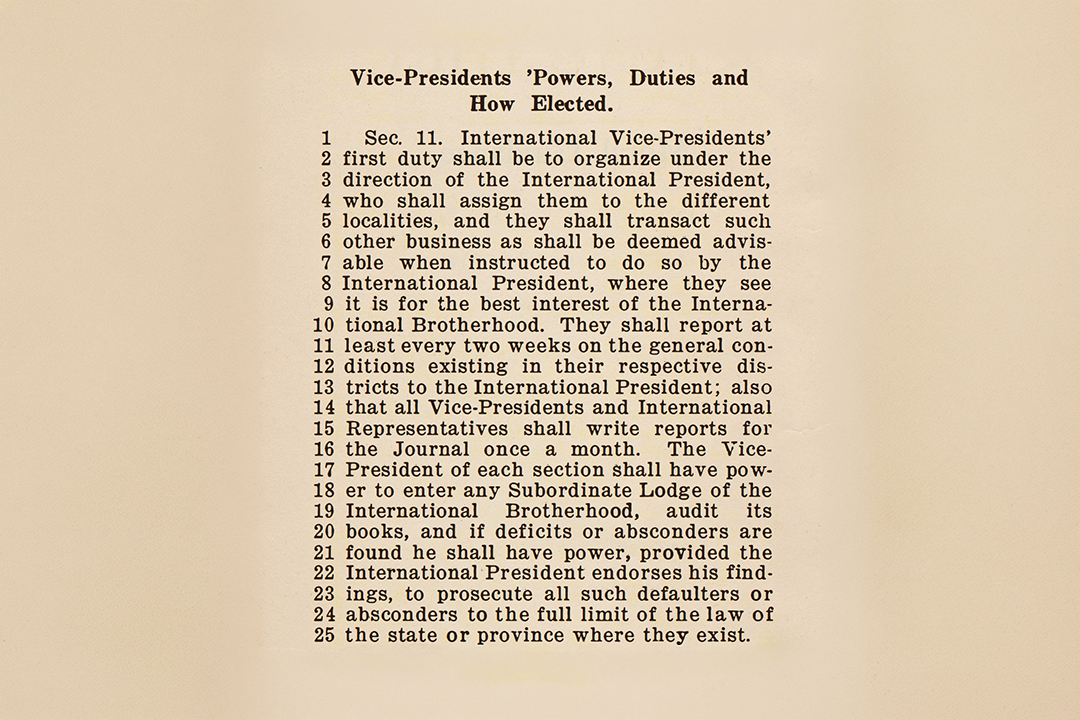
Today, the IEC is returning to those core responsibilities: to organize and to grow. This isn’t a new idea; it’s a return to who we have always been at our best. In less than a year, we have launched nine organizing campaigns and won seven of them. With renewed focus on recruiting and organizing, we’re strengthening our future and offering unorganized workers a path to a better life.
One of the earliest initiatives I brought to the IEC was to encourage every area to hire at least two organizers and recruiters, and the results have been exceptional, with strong support from most area M.O.R.E. Work Action Councils. As part of the effort to organize, I also traveled internationally, with a quick three-day turnaround, to meet with global unions to build relationships and to gain support in organizing efforts and contract negotiations. For example, the global union, IndustriALL, supported our Siemens organizing campaign, because Siemens is an international company. That work has already produced results, including international labor support on our behalf. While the first effort at Siemens did not bring the outcome we hoped for, organizers are already deep into organizing with round two.
The M.O.R.E. Work Investment Fund
The M.O.R.E. Work Investment Fund has made it possible for us to gain market share through job targeting, as well as funding robust organizing and recruiting efforts. It has delivered real results in growth and man-hours. Each area’s M.O.R.E. Work Action Council, made up of CSO business managers and chaired by the area IVP, supports the program’s concepts based on regional needs.
To ensure every contributing lodge had a direct opportunity to use these M.O.R.E. Work Investment Fund resources for local projects and their membership, I presented—and the IEC unanimously approved—a $100,000 stipend for these lodges, to be used within the parameters of the M.O.R.E. Work Investment Fund, for marketing, organizing, recruiting and employment.
To strengthen accountability within the fund, I directed newly hired accountant Joshua Crosland (now Director of Finance) to review how every dollar from the fund was spent. To be clear, no IEC salaries, benefits or expenses are paid from the M.O.R.E. Fund. Only those salaries whose purpose is to carry out and execute the initiatives of the M.O.R.E. Work Investment Fund or to administer the fund is paid from the fund. Any individual whose salary is supported by the fund has been approved by the IEC, and every approval on allocations to date has been unanimous.
Recruitment is now at an all-time high. We have digitized our process, so applicants are no longer lost in the system. Once they apply, they are tracked and given information on how to find employment. One program I’m especially proud of is the online membership application. Any U.S. lodge can use it, while Canada maintains its own system. For the first time in our history, someone who wants to join no longer needs pen and paper, just a cell phone and a credit card. It is a historic step forward for our organization.
Going forward, I want to use this space to be transparent about the good work happening across our union and to speak honestly about what still needs to change. We’ve taken important steps to bring stability, accountability and renewed focus back to this union, but the work is far from over. Every improvement we make is about strengthening opportunities for our members and creating a path forward for the next generation of Boilermakers. I’m proud of the progress we’ve made together, and I’m even more confident in where we’re headed.
Read the 10th Circuit Court of Appeals decision in favor of removing Newton Jones from office.