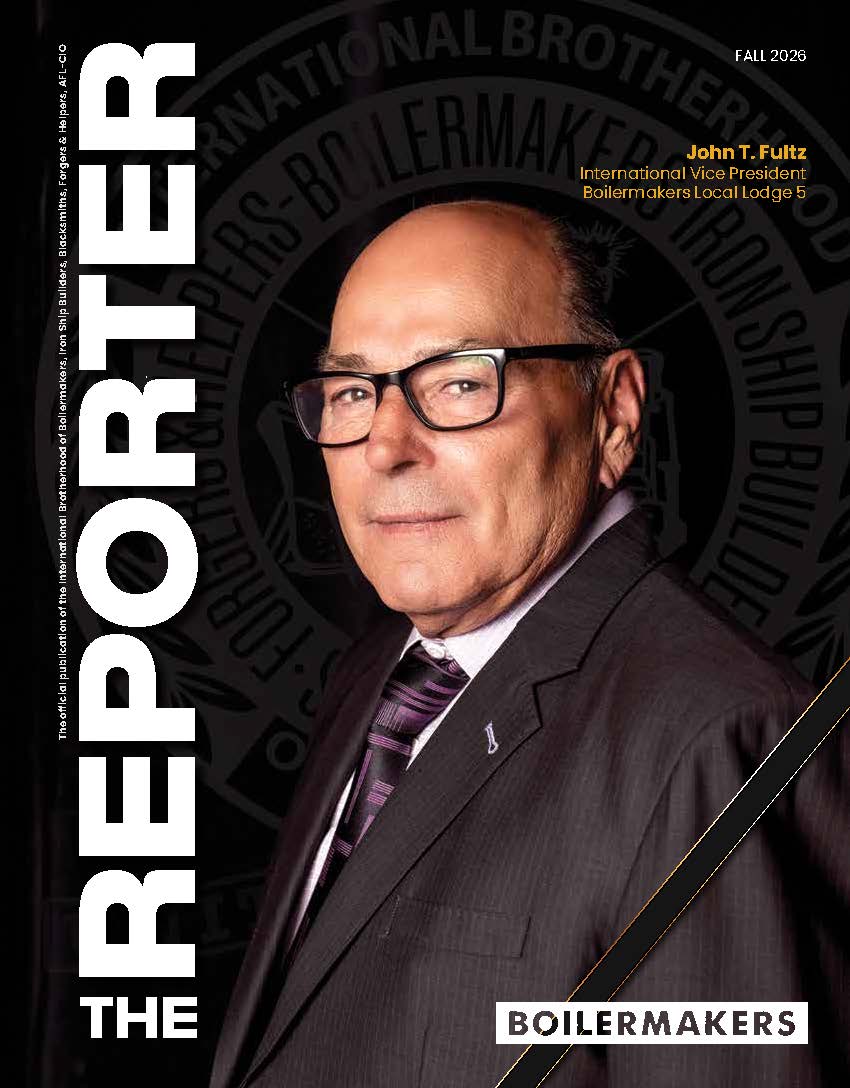
This is our year of growth. We fought hard to get here, and it is time to show our industry the power of the Boilermakers union.
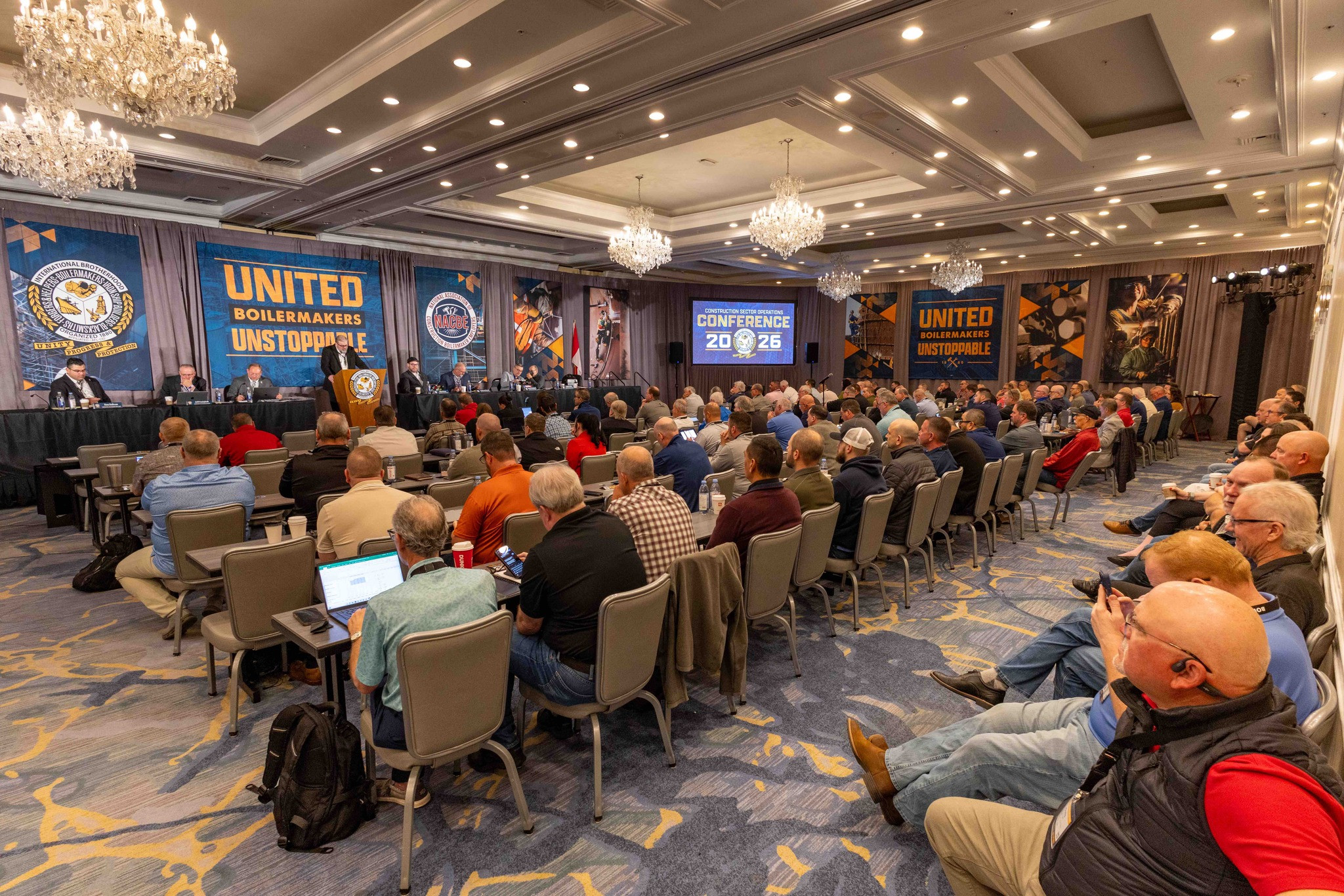


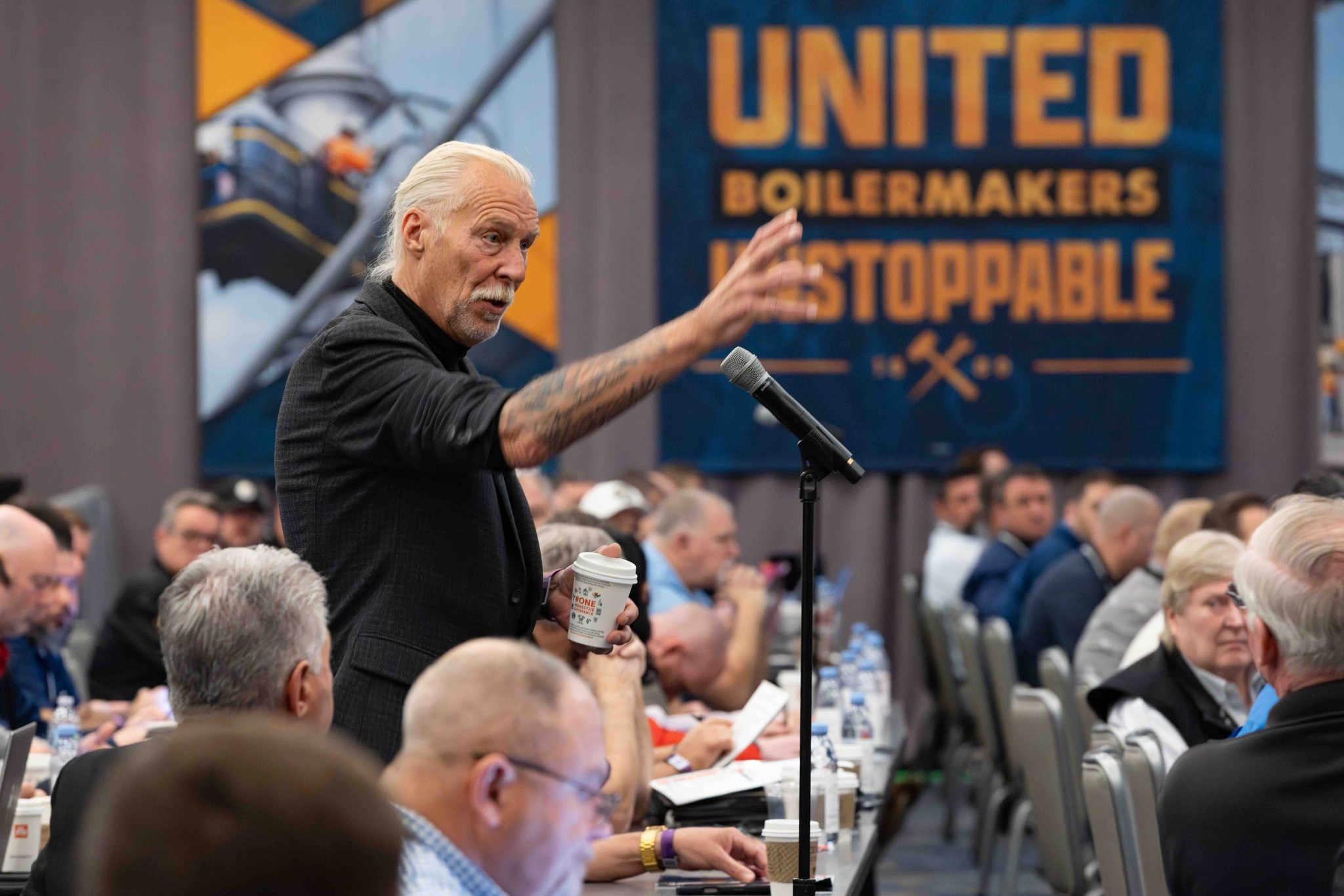
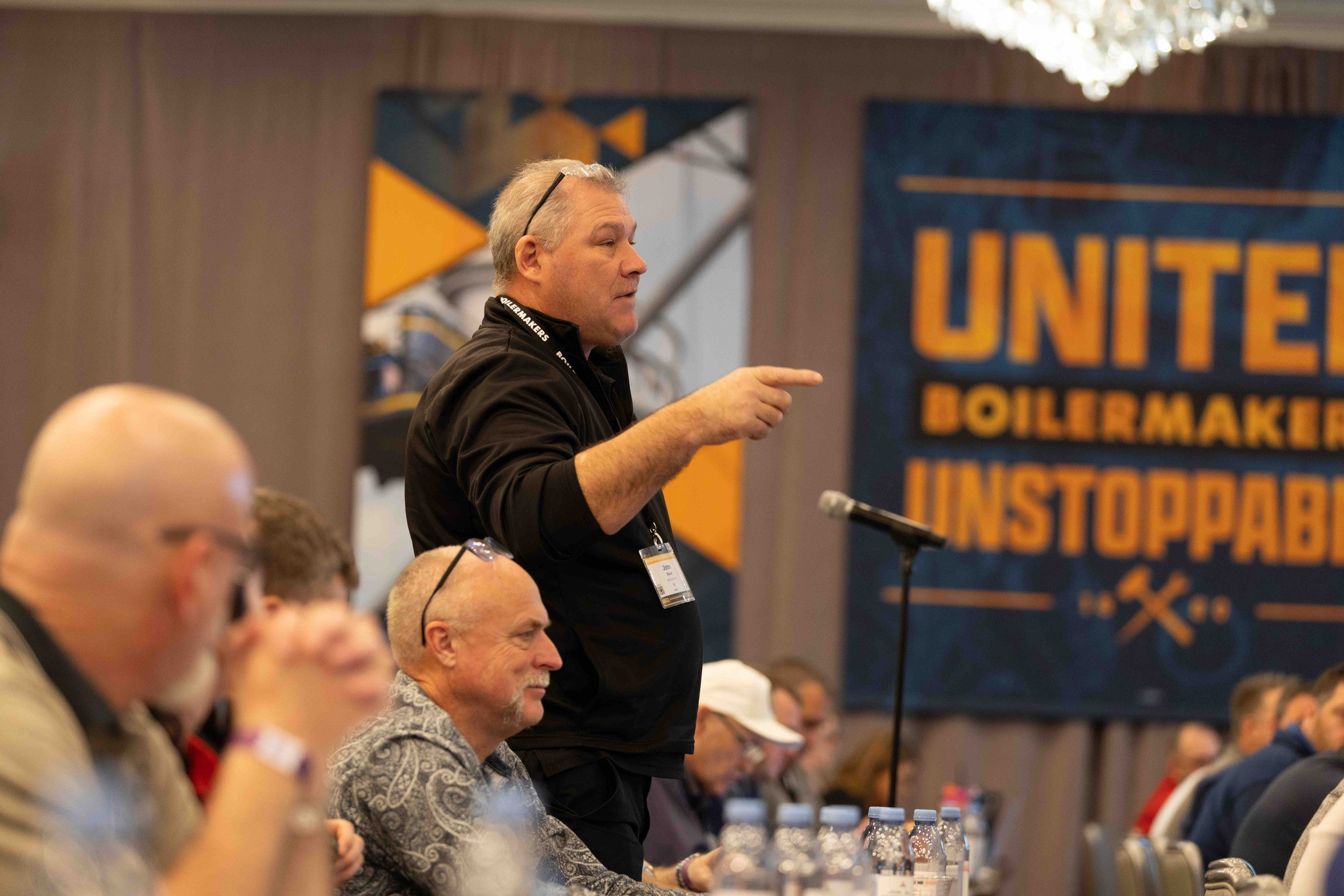


Boilermakers, employers and contractors discuss the future together.
View Photo Gallery (14 photos)
The demand for energy is going nowhere but up as power-hungry data centers continue sprouting across North America to feed artificial intelligence’s ravenous appetite. That’s good news for energy industry owner-employers and good news for the contractors who build and maintain their infrastructure.
Of course, that also means it’s a good opportunity for Boilermakers to man a lot of work for the foreseeable future. But fully seizing the opportunity for Boilermaker owners, for Boilermaker contractors, for the benefit of Boilermaker members and for the Brotherhood as a whole, mandates collaboration and a unified focus on manpower on all fronts. The message was central during the Boilermakers’ 2026 Construction Sector Operations Conference as Boilermakers, employers, contractors and guests met in Marco Island, Florida, Feb. 23-26, under the apt theme “United. Unstoppable.”
International President Timothy Simmons set the tone early in his “State of the Union” remarks, making it clear that growth and renewed momentum define this era for the Boilermakers union.
“This is our year of growth. We fought hard to get here, and it is time to show our industry the power of the Boilermakers union,” he said. “When owners, contractors and organized labor work together and stay united, we are truly unstoppable. There is no project we cannot build, no outage we cannot bring in on time and no problem we cannot solve if we do it together.”
Simmons noted membership and man-hours are increasing, and the union is investing in recruitment, organizing and stronger industry relationships. In expanded recruiting efforts to fulfill contractor and owner manpower needs, the Boilermakers union now has 16 fulltime organizers and recruiters in the United States alone, with more to come.
“Our lodges are energized with new growth opportunities, and we will continue to support them every step of the way,” Simmons said.
He also highlighted improved relationships between the Boilermakers and other building trades unions. Regular communication with counterparts across labor organization helps resolve jurisdictional issues and increases all around cooperation, reducing headaches—or worse—for contractors.
“While we may not always agree, we are not disagreeable. We are finding that middle ground,” he said. “The Boilermakers union has closer ties than ever with our other building unions.”
Simmons outlined several new initiatives, including a Business Manager Advisory Committee, a State Legislative Program and a first-ever National Transient Division conference, hosted by the Boilermakers last August and well attended. Each initiative has the same aim: Secure work for Boilermakers and put skilled-and-trained Boilermakers on those jobs for the union’s contractors and owners.
“We have implemented new programs to make certain we are the craft of choice for many years to come and to make certain that Boilermakers can meet the growing demand from our contractors and owners.” Simmons said.
Tennessee Valley Authority Director of Labor Relations Matt Faulkner described the surging energy demand as “off the charts,” noting that utilities across the country are facing increasing pressure to build new generation capacity while maintaining reliable service. TVA currently has 3,800 megawatts of under construction, including new gas generation, battery storage, solar and continued life-extension investments in nuclear.Additionally, coal-fired plants that were slated for phaseout are now vital and have secured another decade of life extension. The Cumberland Fossil Plant alone, he said, has six 100-day outages on deck.
One of TVA’s greatest challenges is workforce availability.
“We can have all the materials, all the permitting and all the plans, but unless we have the people to do it, we’re not getting anything done,” he said.
One unique way TVA is proactively working with contractors and union crafts is through increased apprenticeship. Faulkner said two years ago TVA asked their contractors and the unions to staff the work at 33.3% apprentices. He said it was a lofty thing to ask, but that’s what’s happening—and it’s working.
“We have more apprentices across TVA right now than we’ve ever had, and we’re more competitive,” Faulkner said. “We can’t build what’s coming without a skilled, strong workforce.”
Cheyenne Gregory, a Local 455 (Muscle Shoals, Alabama) second-year apprentice, is one of those 33.3% apprentices who got her start at TVA’s Cumberland Fossil Plant. Gregory also addressed the CSO audience as a featured speaker to share her experience as a woman working in the Boilermakers trade, as well as her personal story.
“We’ve got a lot of work coming, and we can’t do it alone,” Faulkner went on to say. “We don’t just build power plants together, we build legacies, for us, for myself, for the Boilermakers and the Tennessee Valley.”
Likewise, William “Bill” Murray, Senior Vice President of Corporate Affairs and Communications for Dominion Energy, also emphasized the long-term impact of energy infrastructure work.
“Some of these projects will last 80 years,” he said. “That means they have to be built right.”
Murray said Dominion has worked with Boilermakers for decades. He gave a shout-out to Local 45 (Richmond, Virginia) Business Manager/Secretary-Treasurer Kevin Battle for the local’s support at the first air permit hearing for the company’s $1.5 million Chesterfield Energy project.
“Kevin and his brothers and sisters came dressed for work,” he said. “They weren’t wearing suits and ties.”
Dominion Energy, like TVA, is seeing the skyrocketing demand for energy. But Murray described the demand in higher terms: gigawatts. The term referring to 1,000 megawatts and the term formerly used once a decade is now, he said, used daily.
“This winter in 2026, we broke 25,000 megawatts for the first time,” Murray said. “That means we need to build a lot of power plants…Whatever type of power generation you like, we’re building a bunch of them. Whatever type of power generation you don’t like, we’re building a lot of that too.”
Despite the fact the last “new” refinery was built in the United States in 1977, expansions on existing refineries have allowed capacity to increase. Brett Judkins, Director of Turnaround Excellence for PBF Energy, said partnerships with the building trades, like the Boilermakers, are essential. PBF operates six refineries across the U.S. and puts out about 1 million barrels of product per day.
“Refining remains among the highest work hours for building trades members,” he said. “We can’t do this work without the skilled workforce you provide.”
Judkins described geographic and legislative shifts impacting the industry. The Gulf Coast has always had the largest, growing, footprint because, he said “that’s where the oil is.” But regarding the coasts, he said, the industry trend over the past two decades is that refining capacity has been moving away from the coasts to the middle of the country.
On the West Coast regulatory challenges, particularly in states like California, are a major factor in a shrinking refining industry. California, which was an export market for refined products in the ’80s is now an import market.
“With the recent closure of two refineries, the supply in the state, even with electrification and transport, falls short of the demand,” he said.
“In this challenging environment, our partnership with the building trades has only become more important,” he added. “We need it, and we can’t survive without it. The Boilermakers have been leaders for us supporting our industry.”
Also featured was, Gary Scribner, Assistant Executive Director, Technical, for National Board of Boiler and Pressure Vessel Inspectors, who provided an overview of NBBI. He explained how boiler industry safety standards have developed over more than a century and described NBBI’s role in safety standards. The organization was created in response to catastrophic boiler explosions during the industrial revolution, when more than 1,200 people were killed in accidents over a 10-year period.
NBBI works with regulators and industry stakeholders to ensure boilers and pressure vessels are built, inspected and maintained safely. Inspectors review equipment in power plants, factories, hospitals, schools and countless other facilities.
“Inspectors are everywhere,” Scribner said, explaining that their role is not to perform engineering calculations but to ensure that designs, materials and procedures meet code requirements. The organization also maintains a global registration system for pressure vessels, allowing inspectors and repair companies to identify equipment specifications quickly. Those standards and inspections help protect workers and the public while supporting safe operation of critical infrastructure.
In addition, Boilermakers staff and others provided updates and presented on key areas impacting the union, including the M.O.R.E. Work Investment Fund, organizing and recruitment activities, education and training programs, legislative and political efforts, new web-based and digital tools and other programs specific to the construction sector.