
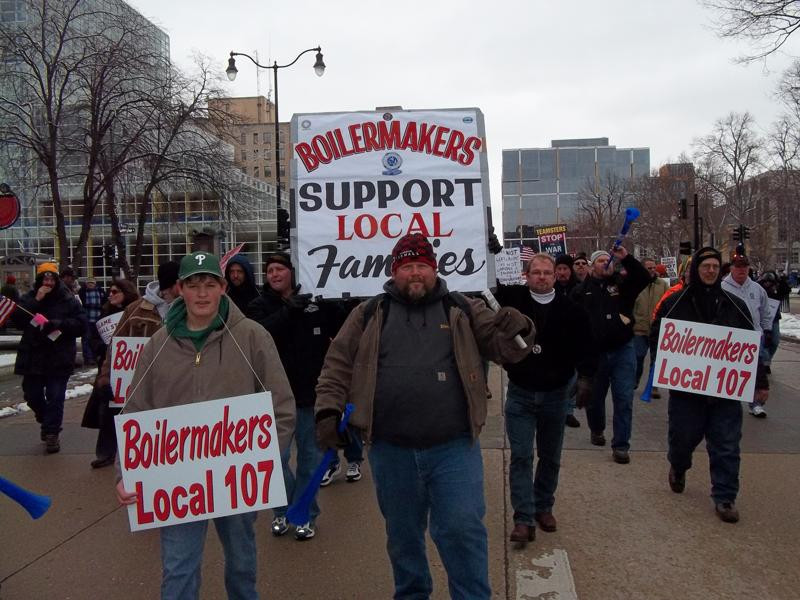
PUBLIC DEMONSTRATIONS opposing anti-worker legislation are continuing throughout the country. Wisconsin, Indiana, Ohio, Michigan, and now Pennsylvania have seen massive demonstrations at their state capitols in support of working families.
In Harrisburg, Pa., last week, hundreds of demonstrators marched in opposition to proposed legislation that would take away workers' rights to a union security clause in their collective bargaining agreements. Known as “right-to-work,” this type of legislation has no purpose other than to weaken labor unions.
An additional bill would prevent unions from automatically collecting dues from municipal, school district, and state employees. Opponents of this law point out that its only effect is to make it more difficult for unions to collect their dues from their members. It does not improve government efficiency, lower costs, or make life better in any way for Pennsylvania taxpayers.
“It’s designed to make life difficult for unions. How easy would it be for the state of Pennsylvania to pay their bills if we passed a law making payroll deduction of state income tax illegal?” one demonstrator asked rhetorically.
These aren’t the first protests in Harrisburg this year. In late March, protestors filled the halls of the Capitol building to oppose Gov. Tom Corbett’s proposals to slash $1.6 billion in funding for schools and the state university system. Corbett is trying to address a $4 billion budget shortfall without raising any taxes. The Governor pledged during his campaign that he would not raise taxes. In fact, he is considering cutting taxes on businesses.
In Olympia, Wash., activists occupying the state Capitol to protest proposed budget cuts were removed by police Thursday, April 7. Thirteen were arrested. The incident caused the state police to bar the public from the main legislative building on Friday.
Gov. Chris Gregoire has proposed cutting $4 billion from the state budget by slashing the education budget, closing prisons, reducing ferry runs, and doing away with the state arts commission, the state tourism office, and subsidized health insurance for 66,000 poor. Tuition at colleges and universities would increase more than 22 percent, while programs for gifted K-12 students would end, class sizes would grow, and teachers would stop receiving cost-of-living raises.
Mark Taylor-Canfield, an organizer with “Occupy Washington,” said protestors want the governor to end tax exemptions for corporations and the wealthy rather than cut programs that help low income and working people. Raising taxes is not an option because an initiative passed in November requires a two-thirds majority of both houses in order to do so.
In Michigan, more than 7,000 workers, students, seniors and others rallied against Gov. Rick Snyder’s (R) proposed budget that cuts corporate taxes by $1.7 billion but raises taxes for low-income families, cuts $900 million from education, taxes pensions, and slashes vital services.
The budget battle follows last month’s fight over Snyder’s “financial marshall law.”
The new law allows the governor to declare a “financial emergency” in a city or school district and appoint a manager with broad powers, including the ability to fire local elected officials, break teachers’ and public workers’ contracts, seize and sell assets, eliminate services — and even eliminate entire cities or school districts without any public input.
Also last month, Snyder signed a new law that cuts state unemployment benefits from 26 weeks to 20 weeks.
More rallies are planned for this weekend. See what others are doing and learn how you can get involved by visiting “We Are One.”